
Vascular Rescue Tests AVAD at the Uniformed Services University
The automated vascular access device has now been run in phantom and swine studies, carrying the full Seldinger procedure from vessel targeting through sheath placement.
MDC Studio portfolio company Vascular Rescue has tested AVAD, its Automated Vascular Access Device, in phantom and animal studies conducted with Dr. Patrick Walker, a U.S. Army Major and a trauma and critical care surgeon at Walter Reed National Military Medical Center, who is program director for the Battlefield Shock and Organ Support team at the Uniformed Services University. The work takes the device to technology readiness level 4.
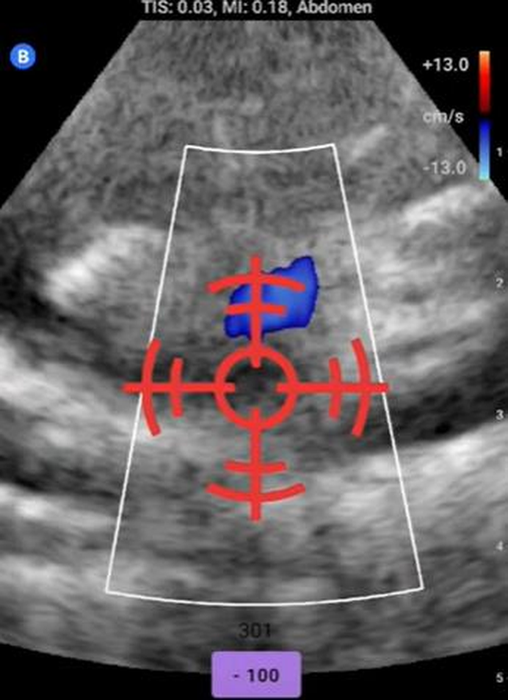
AVAD is a portable, self-contained, self-powered device that performs the Seldinger procedure end to end. A built-in Butterfly IQ color-flow ultrasound identifies the target vessel and displays it under a crosshair. The device then advances the needle along a controlled trajectory, detects puncture electronically, and uses Doppler to distinguish an artery from a vein before advancing the guidewire and placing the sheath.
Vascular access is among the most frequently performed procedures in acute care, and among the least reliable. Central venous catheterisation accounts for five to seven million procedures a year in the United States, with failure and complication rates between 5% and 19%; even ultrasound-guided placement misses 3% to 7% of the time. Arterial cannulation adds a further eight to ten million procedures at similar rates. Each central-line complication adds roughly $26,000 in unreimbursed hospital cost, and a severe arterial complication $50,000 to $100,000.
Both procedures are today performed by specialists. The company's aim is to let a less experienced provider achieve reliable access, which matters most where a specialist is not present: emergency medicine, trauma, and forward military care.
Other automated systems under development, including AI-GUIDE from MIT Lincoln Laboratory and Obvius Robotics' CERTA, automate vessel targeting and needle insertion but leave guidewire insertion and cannulation to the operator. AVAD is designed to automate all four stages. No such system has yet been cleared by the FDA; Vascular Rescue plans a 510(k) pathway with a Q-Sub meeting.
AVAD was invented by Dr. Rajabrata Sarkar, a vascular surgeon and Partner in the MDC Studio, who co-founded Vascular Rescue with Dr. Gil Blankenship, the Studio's founder and the company's interim chief executive. Dr. Jeffrey Gair, principal engineer at the MDC Studio, is co-inventor of the AVAD positioning system. The prototype was built with engineers from UM Ventures and the Fischell Institute under a Maryland Innovation Initiative Phase I grant. The underlying patents are held by the University of Maryland, Baltimore, and are exclusively licensed worldwide to the company.
About Vascular Rescue
Vascular Rescue develops AVAD, an automated device for central and arterial line placement. The company was formed in the MDC Studio and is part of the MDC Studio portfolio. vascularrescue.com
About the MDC Studio
The MDC Studio is a MedTech startup studio in Baltimore, Maryland. It works with clinicians and engineers to turn ideas into working prototypes and into companies, providing engineering, business development, regulatory support, and shared laboratory and office space. The Studio is located in an Opportunity Zone at 300 West Pratt Street. Contact us for more information.