01
Offer-time risk
A calibrated estimate of severe graft dysfunction from donor and recipient registry variables and quality-screened donor CT, combined so the imaging adds signal without drowning out the clinical picture.
VitalMatch by Aerea Medical
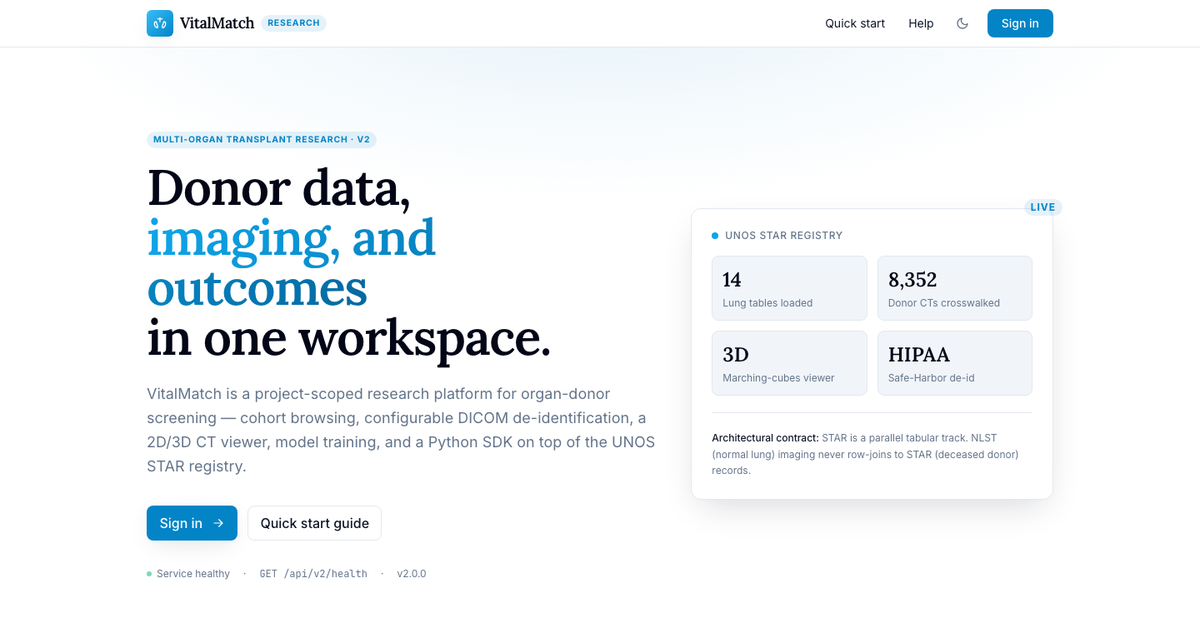
A transplant team has a few hours to accept or decline a donor lung. VitalMatch gives them a calibrated estimate of early graft failure risk for that organ in that recipient, built on national registry data and donor imaging.
The problem
~3,400
U.S. lung transplants a year, across 76 programs, each organ chosen from a registry record, a CT and a phone call.
15–20%
of recipients develop severe primary graft dysfunction within 72 hours: long ventilation, long ICU stays, chronic rejection and death.
0.49–0.61
AUROC of published donor-risk scores on modern U.S. data, barely better than a coin toss.
Molecular tests have transformed care after transplant. The accept-or-decline decision itself still runs on judgment and scores that were never built as calibrated decision software. Declining a usable lung costs a candidate a transplant; accepting the wrong one can cost a life.
The platform
01
A calibrated estimate of severe graft dysfunction from donor and recipient registry variables and quality-screened donor CT, combined so the imaging adds signal without drowning out the clinical picture.
02
A model that reads cell-free DNA results from any laboratory, in whatever units they are reported, and corrects for infection, timing and missing draws. In development.
03
Organ quality and immunologic compatibility (PIRCHE-II epitope matching) scored separately; post-transplant results check every prediction against what happened to the organ.
Evidence
On a held-out, donor-grouped test set of 1,014 transplants, VitalMatch predicts severe primary graft dysfunction at 72 hours with an AUROC of 0.708, against 0.49–0.61 for the published scores we re-implemented on the same patients.
Clinical and imaging data appear to plateau near 0.70 across research groups, which is why the next layer is molecular.
Roadmap
2027
Lock the baseline model; build and test the molecular layer on linked patient cohorts.
2028
Prospective shadow use at partner transplant centers; meet FDA on the regulatory path.
2029
Regulatory filing and first transplant programs on VitalMatch.
2030+
More lung programs, then kidney, heart and liver on the same architecture.
VitalMatch is a research platform today and has not been cleared by the FDA. Its intended use is adjunctive decision support: it never makes the accept-or-decline decision.
Team
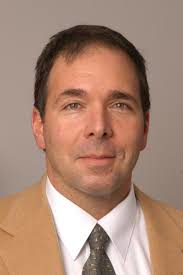
Co-founder and Chief Scientific Officer
Strategic Director of the Northwell Health Lung Transplant Program and Professor at the Zucker School of Medicine at Hofstra/Northwell. A national leader in lung transplantation and advanced lung disease.
Northwell profile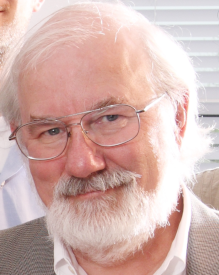
Co-founder and Interim CEO
Engineer and entrepreneur who built the VitalMatch platform. Founder of MDC Studio and of several technology companies, with three exits. Former Professor of Electrical Engineering, University of Maryland. IEEE Life Fellow.
LinkedIn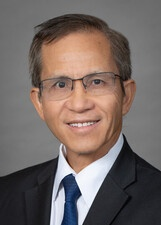
Partner and Surgical Lead
Surgical Director of Lung Transplantation at North Shore University Hospital since 2024, and Professor in the Department of Cardiovascular and Thoracic Surgery at the Zucker School of Medicine at Hofstra/Northwell. He guides how VitalMatch fits surgical selection and the realities of the operating room.
LinkedInDeveloped with clinical and research collaborators at Northwell Health and the University of Maryland School of Medicine, with PIRCHE-II epitope matching through a partnership with Pirche Inc.
Contact
We work with transplant programs, organ procurement organizations, diagnostics companies and investors who want molecular and imaging evidence to count at the offer.
info@mdcstudio.com